Brought to you with support from Broadcast Bionics.
Missed out on one of the talks at Radio TechCon? Need to check a detail you’ve forgotten? Speaker who wants to show off to their mum?
You’re in the right place – relive past Radio TechCon Sessions with our catch-up service.
Watch videos from Radio TechCon 2025 here.
Radio TechCon 2024 – catch up videos
Hosted by: David Lloyd
Videos sponsored by: Broadcast Bionics
Sessions from Monday 25th November 2024
Selling Electric Dreams: 100 years of the Electrical Association for Women
How did the Electrical Association for Women, founded in 1924, use new broadcasting technology to push its message about electricity in the home? And how did it explain these new technologies to its members? Anne Locker, Library and Archives Manager at the IET, draws on the EAW archives held at the IET and the newly digitised Electrical Age journal, first published in 1926.
Lighting up the Lantern – Bauer Media’s New London Broadcast Centre
Bauer has moved from One Golden Square to its new UK HQ in The Lantern. Mark Farrington, Broadcast Systems Manager at Bauer Media, shares his ‘top tips’ for delivering a project as large and complicated as this, as well as shiny studio pictures and stories from the build.
Calculating your Company’s Carbon Footprint
The planet needs all the help it can get – but what can broadcasting companies do to help reduce their carbon footprint? This session will feature practical steps from those who are already on the carbon reduction journey, with Dan McQuillin, Managing Director at Broadcast Bionics, and Andy Land, Global Head of Sustainability at Focusrite PLC.
Mini Masterclass: VR for studio design
The BBC used Virtual Reality to help the design process for studio moves for Radio 2, 6Music and the new Birmingham complex in Digbeth. Mini-masterclass sessions take you from complete beginner to competent bluffer in under half an hour. This session will show you how to use VR to design and refine your studios and tell the story of your grand technical vision to future users. We hear from the BBC’s Spencer Marsden, R&D Engineer, and Thadeous Matthews, Technical Operator.
What has the Transmission Adjudicator ever done for us?
You’ve heard of Ofcom, but do you know much about the Office of the Adjudicator Broadcast Transmission Services? If you don’t, this session will pull back the curtain on some regulation set up in 2008. At first sight, it can seem complicated and even confusing. But it shapes every deal Arqiva does for broadcast transmission. And gives stations and radio groups a bunch of rights to make sure they get a fair deal at a fair price. What has the Transmission Adjudicator ever done for us? As it happens, more than you may realise, as explains by Glyn Jones.
Amazon Alexa Skills: State of the Union
Amazon has introduced the Alexa Radio Skills Kit. What does this mean for radio stations and podcasters? Lead Software Engineer Jamie Woods gives a brief overview of how the skills kit works, and goes over the pros and cons of different approaches to getting your station heard on smart speakers.
Modern Slavery and the Media Industry
Modern slavery might not seem like something which can affect you or your workplace. But with an estimated 120,000 in the UK living in modern slavery, it might be closer than you think. Sustainability and Purpose Catalyst Dr Astrid Leuba has experience fighting human trafficking and modern slavery. She will explain how you may be unwittingly enabling slavery in the workplace or supply chain and give practical examples of how you can spot the signs.
BBC Radio 2’s new studios
The BBC faced a challenge. It needed to move out of Wogan House and build new studios for Radio 2 and 6Music whilst keeping all the studio facilities flexible and dealing with the challenges of networking.
Learn how the BBC brought multi-disciplinary teams together to build something both flexible and easy to use, whilst keeping existing services on air.
How could you prioritise accessibility goals, timelines and lead time challenges on similar projects?
With Dave Walters and Jamie Laundon from BBC Technology & Media Operations – Audio Production.
Making Speech-to-text fair
Speech-to-text has become an essential part of the audio industry – from powering smart speaker controls to writing scripts, we can all make use of it in our daily lives. But what happens if some users are having a better experience than others, purely because of their age and geographic location? Hend ElGhazaly from the University of Sheffield sets out how the algorithms can be improved to make the experience fairer for all.
BFBS – Transmission in the Clouds
With an ever-changing audience that reaches from the UK to Canada, Bahrain, and the Falkland Islands to name a few, learn how BFBS has adapted to provide a trusted distribution platform that serves this wide footprint. Engineers Mark Edgar and Vanessa Tarrier discuss the challenges of global delivery and the solutions BFBS has engineered including moving off prem and into the cloud.
Sounds Good? Measuring mobile streaming
First Reported by BBC R&D to IBC in September 2024 this presentation explains the challenges of how to assess the ability of our mobile phone networks and handsets to deliver a good live radio experience. Using an adapted version of BBC Sounds on Android handsets, the team investigated how different scenarios affected the listening experience and which measures (such as signal strength or buffer size) best allow you to technically assess the performance of the system. Could it be that the longer you cycle for, the longer the buffer gets? We hear from Andrew Murphy, BBC R&D, and Simon Elliot, BBC Distribution.
Behind the scenes of the Sound Bath
The Sound Bath was an innovative installation created for the BBC Proms 2024. In this session, sound designer Yasemin Kahveci takes us through their creation process, including some of the technical secrets and struggles that go into creating audio in 8:1 surround sound. We’re also treated to a short stereo demonstration of the installation. A lovely way to unwind and learn all at once!
The Pips at 100
The pips have been heralding the news and giving accurate time on BBC Radio for 100 years – but why do they exist? How do they work? And what is the nature of time itself? Former Head Of The Pips, Rupert Brun, answers all (in five minutes).
Radio TechCon 2023 – catch up videos
Hosted by: David Lloyd
Videos sponsored by: Broadcast Bionics
Sessions from Monday 27th November 2023
50 Years of Commercial Radio Technology
UK commercial radio celebrates its half century in 2023, but what has it ever done for the technical side of broadcasting? Turns out – an awful lot. Stephanie Hirst will be unpacking her shed to showcase innovations from reel-to-reel to real-time advertising.
Eurovision – Frequency Asked Questions
When large-scale events such as Eurovision or Silverstone take place, thousands of wireless frequencies are in use at once. And one false input could ruin a broadcast. Jaydev Patel and Jonathan Tuck from Ofcom’s spectrum team show us how they support shows in the fight against rogue frequencies.
5G – Fit for a King
The crowning glory of the coronation of King Charles III was, of course, the innovative use of 5G to broadcast the procession. BBC R&D’S Ian Wagdin and Broadcast Engineer Matt Gray will delve into the technical detail around private 5G networks and how they can be used for real.
Based on years of research and development, is the future of reliable 5G contribution now actually here? Discover how, when and what you might need to plan, licence and deploy a real network in the field and find out how it worked on the day of the Coronation itself.
Audio Perception in d/Deaf Audiences
Around 12 million people in the UK have some form of hearing loss. That’s a lot of your listeners. Lena Batra is an expert in the field of hearing, perception and music. In this fascinating session, she explains how d/Deaf audiences perceive sound, and what broadcasters are overlooking when they make assumptions about who is listening – and how.
Keeping Afghanistan On Air
We cross to Kabul, where engineers are working hard to keep stations on air, despite constant threats to their safety. Naim Sarwari, Managing Director of MOBY Group Afghanistan, joined us live from Kabul.
BBC – Broadcasting, Business and Carbon
There’s a climate emergency. But how can broadcasters and radio industry businesses track their actual carbon footprint? BBC Sustainability Manager Alison Butler shows you how, with a particular focus on ‘Scope 3’ – your company’s supply chain.
Russia, Ukraine and the Clone Wars
Transmission experts Arqiva explain the rise in cyber threats as a result of the war in Ukraine, how their own staff have been attacked, and what you need to know to stop your station being taken over by rogue AI presenters. We hear from Arqiva’s Chief Information Security Officer, Denis Onuoha, and Enterprise Architect for Technology, Nathan Dixon.
The Needs of Older Workers
What do you need to do to support those with the most experience in the workplace? Ageism means we don’t value older people or invest in ways to help people age well. Ageism affects people of all ages, but its damaging impact is often felt most strongly as people get older, whether through discrimination in the workplace or being denied access to potentially life-saving healthcare.
In this session, John Kiernan from the Centre for Ageing Better will show you how to support a more positive environment for older workers – as well as what younger people need to do to prepare for a long and happy working life!
Mini Masterclass: Sound Network Design
Mini-masterclasses allow us to get up to speed on a common engineering topic. In this session, networking expert Ross Livings takes you from complete beginner to understanding advanced network design – and how to prevent hackers from taking over your business.
We start with a quick refresher on network basics before we dive into resilience and learn how to recognise and mitigate potential single points of failure. We then delve into security, teaching you how to defend against lurking security risks and minimise lateral movement in your network. And finally, we discuss micro-segmentation and virtualisation. These powerful dynamic tools will help you strike the perfect balance between security and flexibility, taking your network to the next level.
Whether you’re just starting out in the network world or you’re a seasoned pro, this mini-masterclass is here to empower you with the knowledge you need for broadcast media in the 21st century.
Podcasting, the Next Chapter with AI
There’s a lot of buzz around AI at present, but not much practical information. At Radio TechCon, you’ll be among the first in the world to hear the latest research on using AI for podcast segmentation.
This session with PhD Researcher Jemily Rime focuses on practical uses of AI for audio production and podcasting, introducing – for the first time ever – pod-CLIPR (Podcast Chapterisation through Intelligent Pattern Recognition), an algorithm that automatically segments audio based on sound event detection. We will look at the potential applications of pod-CLIPR and implications for next-generation podcasting.
Sun, Sea and Wavebands
Radio Caroline is a community radio station which operates from a boat – the Ross Revenge. Their transmission base is on land in an abandoned BBC World Service site. The station – whose name stretches back to the original pirate radio era – broadcasts on AM, SSDAB and online.
Electricity costs were rising and so instead of shutting down expensive AM services, the volunteer-run team turned to solar power in a bid to reduce costs. Station Engineer Alan Beech shares the lessons learned, the challenges faced when broadcasting at sea – and how your radio station could benefit from being run by the sun (even when it’s raining…).
A Tale of Two Cities – and 5 Live Studios
When BBC Radio 5Live revamped the Voice of the Nation show, they faced two challenges. Not only did the programme have to be simulcast on radio, TV, and iPlayer, but the workflow had to operate seamlessly between a team working in London and Salford at the same time. In this session we hear from Technical Production Manager, Gary Boast and Lead Technical Operator, Felicity Norton. You’ll learn how it was done – and how hard keeping things in synch across multiple platforms while pushing the boundaries of visualised radio can be!
Radio TechCon 2022 – catch up videos
Hosted by: David Lloyd
Videos sponsored by: Broadcast Bionics
Sessions from Monday 28th November 2022
Ukraine: Staying On Air
On 24th February 2022, Russian forces launched attacks on Ukraine. In the midst of this international crisis, the Public Broadcasting Company of Ukraine, Suspilne, has continued to broadcast.
Speaking live from a secret location in Ukraine, Suspilne Radio’s Executive Producer Yevheniy Chyzh describes how broadcast engineers and producers are staying on air during the war with Russia, as well as the skills every broadcaster needs to know to prepare for emergency situations.
100 Years of BBC Technology in a Dozen Objects
2022 marked one hundred years of the BBC. Speaking from the building where it all began, Savoy Place, Dr Rachel Boon, curator of computers and communications at the Science Museum is joined by tech experts Bill Thompson and Simone Eubanks from BBC Research & Development. They show us a series of objects that tell the story of the BBC’s technical history, covering radio, TV and online. Here’s a hundred year journey and a glimpse into what the next hundred might hold.
Adding Neurodivergence to the Mix
How do neurodivergent listeners process sound? Samera Haynes, Managing Director of Frank Communications joins Dr Lauren Ward, Media Accessibility Research Fellow at University of York to share recent research findings. They reveal what audio experiences autistic audiences are seeking out, and how to mix your show to include neurodivergent listeners.
TalkTV: Telly on the Radio
TalkTV launched in 2022 – but much of its technology is actually powered by radio systems. Chris Thame, Lead Stations Engineer at NewsUK explains how it’s done, and what radio technologists need to know when their bosses announce they need to start doing TV…
World Radio Congress
Spectrum is up for grabs at international level – mobile phone companies would like some of the frequencies used by broadcasters for programmes and also wireless microphones used on OBs.
David Hemingway is Senior Distribution Manager at the BBC and chair of the EBU Special Programme on Spectrum. In this short session he outlines some of the issues and explains how you can get involved in influencing international policy.
Defaking News
In an era of deepfakes, how do media outlets ensure their audiences know they are who they say they are? Kate Brightwell from Adobe will explain a new open-source system for marking your content and increasing trust online.
Kate joined Adobe in 2016 and is Head of Policy and Government Relations for UK and Europe. She leads Adobe’s policy work in the UK, its second largest market, and Adobe’s advocacy in the EU on issues such as Artificial Intelligence and disinformation.
Mini Masterclass: Mental Wellbeing at Work
The last few years have been especially stressful. There are all kinds of schemes for helping to ensure mental wellbeing in the workplace – but how do you move from statements of intent to actually having a mentally healthy workplace in practice?
Mental Health First Aider and Consultant, Jude Spencer shares top tips on how to look after yourself and your colleagues, with practical skills and an action plan for your own place of work.
Adaptive Podcasting
How can you make your podcast more relevant to your audiences by updating automatically – without privacy issues? Ian Forrester and Rebecca Saw reveal the latest technology from BBC Research & Development.
Winter Is Coming
Are you ready for power cuts this winter? And what about equipment safety during weather extremes. Arqiva’s Operational Resilience Manager, Alison Craddock reveals how they plan for winter emergencies and gives tips on how your organisation can do the same.
London Bridge
The death of Queen Elizabeth II presented one of the most complex technical challenges the UK broadcast industry has faced.
Ioana Barbu, Production Support Engineer at Global and Bob Nettle, Technical Producer at the BBC share behind-the-scenes stories from those at the sharp end. They discuss how broadcasters worked together to share resources, what happens when those plans meet first contact during the biggest breaking news story of many people’s careers, and how to keep a steady hand on the faders when you know millions of people are listening.
The Acoustic Properties of Materials
Through interactive demos, chocolate & ice cream, and the odd loud noise or puff of smoke, Dr Zoe Laughlin demonstrates the acoustic properties of materials – with a bang.
Dr Zoe Laughlin is a co-founder and Director of the Institute of Making, and TV and radio presenter. Working at the interface of the science, art, craft and design of materials, outputs range from formal experiments with matter, to large-scale public exhibitions and events.
Radio TechCon 2021 – catch up videos
Hosted by: David Lloyd
Videos sponsored by: Broadcast Bionics
Sessions from Monday 29th November 2021 – virtual event
Stay tuned for weekly videos from Radio TechCon 2021…
A Talented Future for Radio
How do we attract new talent to broadcast engineering – and how do we make them stay?
Engineers-to-be have some much choice when it come to Apprenticeships. Broadcast engineering companies are competing with the likes of Google and Facebook, as well as related industries with higher pay. So how do we attract new talent to radio? And what do we need to do to ensure newer engineers stay?
Dilani Selvanathan began her career at the BBC before moving to work in other fields. She has already been recognised by the IET for her work in encouraging young people into engineering. She shares her insights about what we’re getting right – and what our industry needs to do to attract the engineering talent of the future.
Covering South Africa with Digital Sounds
How do you cover a country with a land area 5 times that of the UK with Digital Radio?
At 1.22 million sq kilometres, providing adequate radio coverage presents significant challenges.
After some years of deliberation the South African authorities have announced that they will introduce Digital Radio to their country. This will be achieved by a unique combination of Digital Radio Mondial and EU147 DAB digital platforms. These two digital broadcast standards will provide both the long range and local coverage that this vast country requires.
Aldred Dreyer from the SA DRM Group and Radu Obreja from the DRM Consortium tell the story of their contribution to this massive undertaking.
Boom without a Box
The team at Boom Radio decided to build a radio station… with no studios, no buildings, no racks room and at the height of a national lockdown when visits to presenters’ homes weren’t possible.
Hear from David Lloyd and Quentin Howard about how Boom Radio solved an alphabet soup of technical and human challenges, from Acoustics to Zetta, and launched one of the most successful new stations in recent years.
Unmixing: Having Your Cake AND the Ingredients
Next Generation Audio (NGA) allows speech and other sounds to be kept separate until the final mix is created in the consumer device, enabling a range of personalisation options.
But a great deal of ready-mixed content already exists, and new content is seldom created with different sounds kept separate. To offer the benefits of NGA within existing workflows we need to ‘unmix’ the audio.
Speakers Iain McClenaghan (BBC R&D) and Aimée Moulson (Fraunhofer IIS) explain how this source separation is achieved using artificial intelligence techniques.
They then tell us how well it actually works!
Smarter Syndication – A Tale of Splits, Sockets and Carson Daly
How can a syndicated show be recorded and delivered differently in 2021 to allow each station taking the show to have a bespoke version?
Gav Richards is the host of 10 Most Wanted, a nightly syndicated chart show with a difference… Each station that takes the show gets their own station namechecks, mentions of the local area and presenters, and can run to time with whatever requirements the station has.
This is all achieved through a system developed by Gav which we see in action in this Radio TechCon 2021 session. Watch now to learn more of the concepts involved.
Mini-Masterclass: Latency – the talk you’ve been waiting for
Latency has become especially topical over the last couple of years!
When working at a distance we are faced with technological and performative processes that disrupt synchronisation. Limitations and constraints that might cause frustration can in fact be exploited for new creative strategies for musicians, broadcasters, podcasters and other producers of time-based media. These creative strategies not only accommodate the inconveniences of latency and acoustic feedback but can actually help us adapt and transform how we engage in real-time online.
Rebekah Wilson is a composer, musician, technical co-founder and CEO of Source Elements. In this mini-masterclass, Rebekah shares her insights and work on addressing latency to optimise real-time remote collaboration.
Unwrapping BBC MakerBox
MakerBox from BBC Research & Development is the community where the weird and wonderful collide! Having developed new tools, the BBC wants to share what it’s learned with the community looking to innovate at the leading edge of broadcasting.
Senior Product Manager Laura Harrison and Lead R&D Engineer Jon Francomb from the BBC explain the MakerBox platform, where there are currently six tools available for you to try.
Check Out My Tune
Ever tried mixing Indian music? Regina Balachanthiran discovered that most music editing software can’t handle it – so she taught herself to code and set out to solve the problem.
Hear from Regina how she created her own plugin to handle Indian music ragas, and put your own tonal detection skills to the test!
LBC’s Latest Brilliant Creation
Global Engineers Jon Crew and Ioana Barbu, along with Will Batchelor, LBC’s Studio Video Producer, show you behind the scenes of Global’s Video and Radio studio located at 4 Millbank. They’ll show you how it was built, how the requirements suddenly changed during lockdown and the work that’s gone on in the last 18 months to perfect the workflow and get the very best out of the technology and content.
Radio TechCon 2020 – catch up videos
Hosted by: David Lloyd
Videos sponsored by: Broadcast Bionics
Sessions from Monday, 30th November 2020 – virtual event
Watt now? Watt if? The Hidden Power of Radio
There are various studies investigating the environmental impact of digital technology and services, but limited research dedicated to radio broadcast and listening. With changes to the radio industry on the horizon, such as a potential digital switchover or greater uptake of internet-connected devices, it’s important we understand how both industry and consumer decisions could impact the environment.
In this session, Chloe Fletcher from BBC R&D will explore how much energy is currently needed to prepare, distribute and consume BBC radio services, and how this may change over the next 20 years.
Multitrack
The Multitrack Audio Fellowship helps people from under-represented backgrounds find paid internships within the radio industry. In this session, Lisa Hack gives a brief introduction to the scheme and explains how technology teams can help.
Pencadlys BBC Cymru Wales
Building a new broadcasting centre from scratch is a huge project which can span years. So how do engineers, project managers and production users work together on complex projects, and what lessons can be learned for the future?
In this session, Lead Architect Mark Patrick and Producer Sharif Shahwan take you behind-the-scenes of the BBC’s new Cardiff HQ, and share tips on how to get the most out of your project team (and vice-versa).
If you have considered a shift to a career in major projects engineering, this is for you!
VIP Voice Control
The RNIB has developed all kinds of innovative technologies to allow Visually Impaired audiences to access content on smart speakers. Visually Impaired users are experts at voice control – so what can smart speaker skill designers learn to make their apps more navigable? Senior Innovation Manager Robin Spinks reveals all.
A Face(book) for Radio: VR sound and audio innovation
Broaden your (Facebook) Horizons – VR has been the ‘almost there’ technology for years, but under the bonnet, audio is the key to its success. In this session, Caleb Epps from Facebook Horizon’s Sound design team, explains how VR audio works, and how the technology can be used in the wider audio world – including at your radio station.
Hey Beeb!
The story behind the BBC’s ‘Beeb’ voice assistant, how it works, why it’s not competing with Google and Amazon… and why it can speak in different accents. Head of Product Andy Webb introduces Auntie’s new voice.
Don’t Mux It Up
Are you a bit hazy on SId Codes? Not sure how to troubleshoot a weird character appearing on your station’s DLS display? In this session, Ash Elford will give you a whistle-stop tour of the basics every engineer needs to know about making their radio station look good on DAB.
Times Radio: Plandemic B
Launching a new speech radio station on a tight deadline is tough. Where are the studios going to be? How will the staff be trained? Are there enough supplies of tea and gaffer tape? Times Radio had to cope with all of these challenges – and then along came Covid-19.
One year on from the launch, take a look back with Lead Stations Engineer Chris Thame to find out how the team managed to get on air whilst staying 2m apart.
It Is Rocket Science – How NASA Does Sound
NASA broadcasts thousands of hours of televised and internet-streamed content from space. But what is happening behind-the-scenes? How does the world get to hear the instructions for ground control, and who teaches the astronauts how to use a microphone? NASA’s Emmy Award-winning sound engineer Alexandria Perryman reveals all.
The Internet Monkey Cage
The pandemic has affected all of our workflows, as staying at home became the new going out. But how does that work when you normally have lots of guests in a studio …or need to record an audience laughing in real time?
The BBC’s Matthew Page tells the story behind its Pre Rec and Virtual Audience systems, with a special guest contribution from Robin Ince from the Infinite Monkey Cage.
DAraBic
The ability to display station names, programme types and dynamic text is very much part of the appeal of DAB and DRM as a modern digital radio technology, but if they are going to become truly global and ubiquitous, then they will need to be fluent in more than Latin script.
The BBC’s Abdallah al-Salmi explains the complexities of Arabic script display and how the ETSI standards of DAB and DRM have been updated in order to support the growing requirements of broadcasters across the world.
Freelance Your Future
The last couple of years have seen huge changes in our industry. Many people have been made redundant, and others have found new ways of working due to the pandemic.
Whether you are freelance, employed or thinking about making the leap, discover what you need to help you make sound financial foundations today and to deliver on your goals tomorrow.
In this session, financial planner Emily Man looks at the practical, legal and financial things you need to consider if you become self-employed – and what you need to know if you are hiring freelance talent. This session could change your financial life!
LUFFing Your Workflow
You may know the theory of LUFS and EBU R 128, but how do you incorporate Loudness in your production processes and working practices?
How do you get your studio output to conform with EBU R 128 and what’s the advantage?
Wolfgang Rein shares the lessons he learned from SWR in Germany.
Audio DNA: Next generation tools for Next Generation Audio
Next Generation Audio (NGA) is like the DNA of audio, as it helps you make the best use of your station’s metadata. But how do you get different Next Generation Audio systems to work together? The EBU’s Paola Sunna has an answer for that…
Radio TechCon 2019 – catch up videos
Hosted by: David Lloyd
Videos sponsored by: Broadcast Bionics
Sessions from Monday 25th November 2019 at IET London: Savoy Place
Radio TechCon 2019 Highlights
Radio TechCon 2019 – the highlights.
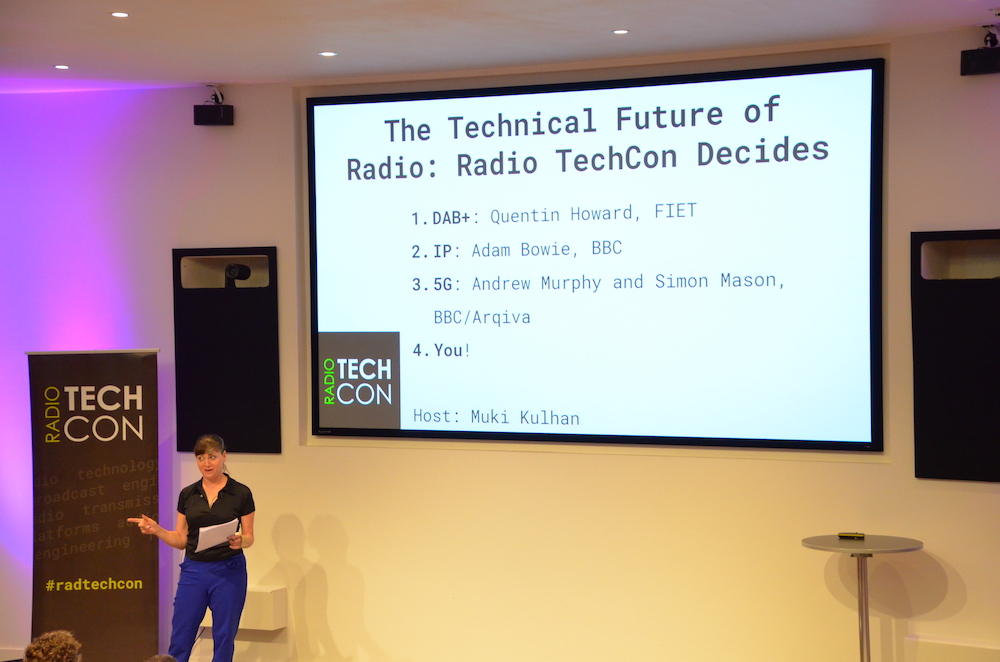
The Technical Future of Radio – Radio TechCon Decides
What should be the future of radio? DAB+? IP? 5G? What are the pros and cons of each system? How would the industry prepare if we had to switch over to these formats?
In this session, Quentin Howard, Adam Bowie, Andrew Murphy and Simon Mason conduct a thought experiment. We pretend that the industry is only allowed to pick one option.
Prepare for good-natured debate – and remember, this is for fun and not the opinion of our speakers or their employers.
Session host: Muki Kulhan.
Illustrated notes by Katie Chappell.
The Technology Behind Brexitcast
Sound the Klaxon! The team behind hit podcast Brexitcast explain how it gets to your ears …and your eyes.
Brexitcast (aka Newscast, Electioncast and The Coronavirus Newscast) is the BBC’s nerdy podcast covering all things Brexit. In this session, Dino Sofos and Robin Pembrooke explain the show’s unusual workflow, how the presenters contribute from all over the world, and what changes the team has had to make now the show is visualised for television.
Mini Masterclass: UWot? An introduction to UI and UX
What on earth does UX and UI really mean in practice? Go from bluffer to blagger in 30 minutes!
UX and UI are important for designing studios, software, and the interfaces our audiences use. But what is ‘good’ design? What do you need to do when creating a new system? And is it ever OK to let an engineer choose the layout? Bekki Leaver is here to explain all…
Super Sound Bars: You won’t believe your ears
Experience immersive sound bar technology, based on 3D audio technology conceived at the University of Southampton and developed by Audioscenic.
Marcos Simón Gálvez explains how their beam-forming technology works, as well as how this is being developed to serve multiple listeners simultaneously.
Dealing With Change
2019 was a tumultuous year for the industry, so we had HR and psychotherapy expert E-J James on hand to help you deal with changes in the workplace.
This session involves the contemplation of your own death (before lunchtime).
Wireless on the Move
Nick Prater and Chris Thame tell the story behind Wireless Group’s move to London Bridge, including moving Virgin Radio …twice.
Mini Masterclass: Audio Acoustics, it’s (almost) all about the bass
Bruno Fazenda from the University of Salford explains how audio really works …and how to deal with acoustic problems in spaces used for monitoring audio.
Software for Studios
How do you design software that meets presenters’ needs without having 100 screens in the studio? The team from VRT have been testing modular studio designs. Sandy Claes reveals how they got on and how you can use similar technology in your station.
Building your own SSDAB Mux
Want to build a SSDAB Mux but don’t know where to start? This session is for you!
Small-Scale DAB has been a revolution for community stations – but what happens if you are asked to build your own Mux? Lawrie Hallett has run the Norwich Mux for several years and will take you through the pros and cons of doing everything yourself vs. buying equipment off the shelf.
TeNMOS
The NMOS standard explained in 10 minutes.
A lightning guide by the BBC R&D’s Andrew Bonney on an emerging key spec for the world of IP-based media.
The Advanced Media Workflow Association [AMWA] has developed the Networked Media Open Specifications [NMOS] which have been developed to help all of those making media to connect stuff together as simply as possible. The different components cover Discovery, Registration, Connection, Network Control, GPIO, Authorisation and much more. Start to learn what to write into your requirements and build in to your products, as well as how to conceive a better systems architecture for your IP-based media infrastructure.
Teaching Radio Studios to Fly
The BBC is on a mission to create ‘The Best Described Audio In The World’ through the application of Machine Learning techniques. Learn how their new product ‘Fenchurch’ is starting to tease out what really happens in the studio using enterprise-level transcription and semantic analysis.
Session presenters: Luke Eldridge and Chris Roberts.
Transferable Audio Skills
Leslie Gaston-Bird – a Governor-at-large of the AES – on having a varied career in sound.
In this talk, Leslie will provide you with an overview of how to leverage versatility as an asset. If you work in radio, you probably have more skills than you first thought!
Radio Technology Masterclass 2019 – catch up videos
Radio TechCon’s Radio Technology Masterclass has its own page: Introduction to Broadcast Engineering.
Radio TechCon – pre 2019
We don’t have videos from before 2019, but you can find out about the Sessions and Speakers on our History page.
Be the first to hear the news about this year’s Radio TechCon by adding your e-mail below.