Watch sessions again from Radio TechCon 2025, supported by Broadcast Bionics.
Missed out on a session? Need to check back on the detail? Want to share some inspiration with your team?
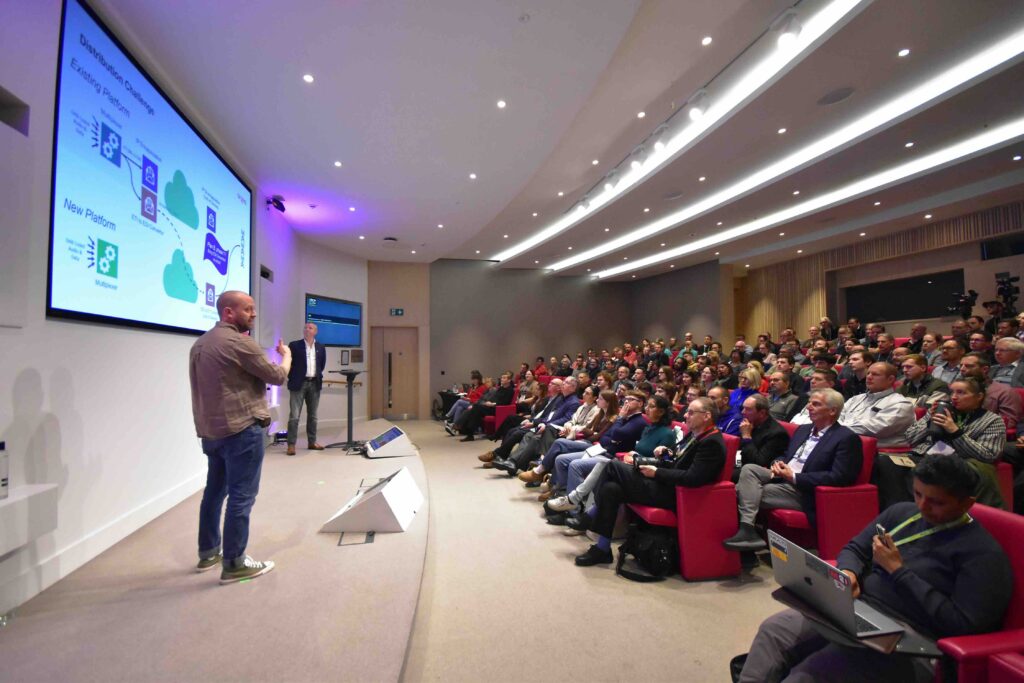
Radio TechCon 2025 took place at IET London: Savoy Place on Tuesday 25th November. We’ll be sharing sessions from the day and you can also watch videos from previous events.
Thanks to our host David Lloyd and Headline Sponsor Broadcast Bionics, who also kindly support these videos to bring to you for free.
Be the first to know about new videos releases by signing up to the Radio TechCon newsletter:
LBC’s Millbank 2.0
When Global decided to give LBC a new home at 4 Millbank, the brief was simple: build something four times bigger, twice as clever, and ideally without anyone moaning about the chairs.
Jon Crew from Global lifts the lid on how the team transformed a cramped radio studio into a state-of-the-art broadcast hub – taming tech from different manufacturers, gluing it all together with Node-RED wizardry, and discovering that comfort really does improve content.
Machine Learning Sounds Terrible
The BBC Master Control Room monitor hundreds of audio feeds from Tx to Rx and use a range of standard tools for silence, phase and over-modulation. What is much harder is to monitor all of those feeds simultaniously for partial circuit faults.
As part of a development project, the BBC looked at Machine Learning to characterise the spectral responses of what good looks like, to indicate when something unusual is happening and alert the Control Room team to take a listen to a particular feed. In this session, the BBC’s Matthew Martin delves into how machines can filter and reduce audio to a number of key indicators that can be modelled and monitored, with maths and graphs
When the lights go out (but you didn’t throw the switch)
Our organisations all have contingency plans for the big one but how often do we ever get to test them?
When the power across the Iberian peninsula failed on the 28th of April 2025 it was the most severe blackout in Europe for 20 years and the first of this kind. How did the plans of Portugal’s Public Service Broadcaster, RTP, hold up? What services did their audiences want and what could they provide?
Find out from Monica Palomo, RTP’s Director of Engineering, Systems and Technology, as she explains the background, the impact, and the lessons learnt.
On-The-Grid: Solar Power in Ghana
BBC World Service’s transmission site in Ghana found the tipping point where the business case for operating on renewable energy made more sense than relying on the local power grid. Solar power was also a boon to other broadcasters using the same transmission site.
Could this power-sharing solution work in a rainy UK? BBC Distribution Development’s Daniyal Shah tells us more.
Community to Cloud
Castledown FM faced an issue. They had to leave the building which had housed their studios for many years and move into a much smaller space at short notice.
John Sparrow shares how they handled the rebuild, including moving their playout into the Cloud, and how smaller stations meet the challenges of staying on air with limited budgets and technical support.
From Cockpits to Studios – Human Factors in Broadcast Engineering
What can we learn from aviation on how to run high-pressure and technically complex environments like studios and broadcast transmission chains safely – especially when things go wrong and emotions run high?
Dr James Taylor brings his expertise on Human Factors in airline safety and crew resource management to the radio industry.
Mini Masterclass: AI for Audio
It’s almost impossible to have a technology conference without a mention of AI – but what exactly is it? How does it work? How are LLMs different from search engines? What does the future hold, and what do you need to know now to be ready?
Industry expert Marianne Bouchart takes you from the foundational knowledge you need to know to confidently navigate generative AI, to a look into what we can expect from AI in the future. They also review useful production tools and give in-depth explanations of what these systems are actually doing.
The Radio TechCon Mini Masterclass sessions offer a revision of popular industry topics: from beginner to bluffer in under 30 minutes.
Replatforming Digital Radio
Arqiva provides the platform for the majority of digital radio in the UK and in 2025, after many years of development, they migrated all operations to an entirely new platform – from contribution to muxing and distribution. It’s a large and complex network! Hear from Arqiva’s Richard Johnston and Richard Knight about the design decisions that were made through the process, lessons learned and how they ultimately migrated the UK’s national muxes with almost no one knowing about it…
CTRL+WIN: The BFBS Esports Revolution
What do you get when a high-octane military esports tournament collides with broadcasting?
BFBS’ live events manager Angie Avilanos and broadcast engineer James Smith reveal the madness behind turning the button-mashing mayhem into a seamless livestream.
From wrangling consoles to keeping commentary entertaining for forces audiences around the world, they share the clever hacks, technical wizardry, and transferable skills broadcasting brings to one of the fast-growing industries around. Expect the highs, the lows, a special dog and an ice cream van.
What happened to the horse in Nybro?
AI-powered search on the Sveriges Radio (SR) mobile app is now helping audiences to explore news stories by asking questions and getting reliable summaries sourced only from the Swedish public broadcaster’s own journalism. With an AI-powered news search users can get updated on the major and most recent events, as well as the local stories in the past. Like what can happen to horses in mud.
Jörgen Bang, Product Owner at SR, is part of the group that develops the service. In this session, he shares all the why’s and how’s around it.
From Pets to Fabric: The Software-Defined Future of Broadcasting
TAMS, DMF, MXL – there are loads of new standards on the horizon which give radio and audio technologists scope for lots of creative new approaches! Learn the basics of what these can do – and why they are important – with Dan McQuillin from Broadcast Bionics.
Cleaning up a muddy Glastonbury
Open-air stages at festivals are noisy, uncontrolled environments. Vocal mics pick up unwanted drums, guitars and crowd.
Find out from BBC Senior Technical Producer Simone Lombardi how audio at festivals is cleaned up in real time.
Check out more videos from previous Radio TechCon events, including an Introduction to Broadcast Engineering.